

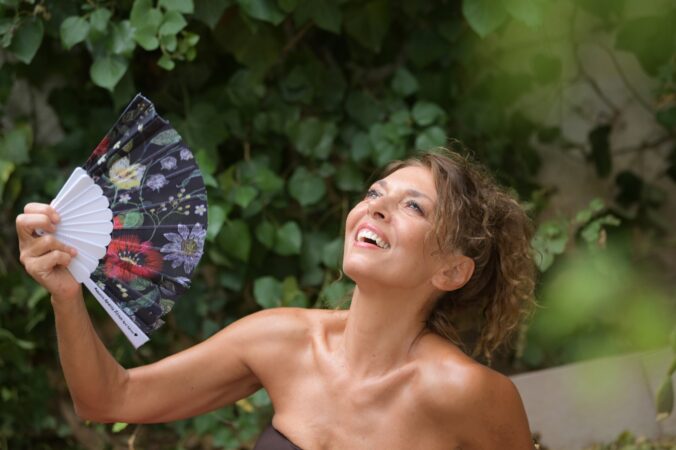
Actress, writer and creator Dimitra Papadima has followed a unique artistic path shaped as much by chance as by determination. Her journey into acting began unexpectedly when a chance encounter led her from an office job into the world of modeling and ultimately to the guidance of the legendary Greek actress Irene Papas, who encouraged her to pursue the stage. Throughout her career, Papadima has brought to life remarkable historical figures such as Penelope Delta and Marika Kotopouli, while also developing her own voice as a playwright and novelist. Deeply passionate about storytelling, she views writing as an essential part of her creative identity. In this interview, she reflects on her career, challenges, artistic philosophy and the enduring pursuit of personal victory.
Could you share your journey into acting and what inspired you to follow this path?
My journey began unexpectedly, and that is what makes the story of my life interesting. I started in a completely different direction. I was waiting at a bus stop to go home from the office where I was working at the time, an office environment that clearly did not suit me, but I needed a job. I was eighteen years old when, at that bus stop, someone suggested that I try modeling. I spent some time in that field, but I quickly realized it was not the profession for me. By chance, through the people I met, I found myself close to Irene Papas. She was the one who encouraged me to become an actress.
What is the most memorable role you have played so far, and why?
Two roles have left a profound mark on me, and I continue to serve them to this day. Two extraordinary personalities: Penelope Delta and Marika Kotopouli. After extensive research and hard work, I brought them to life on stage and I will continue to do so through theatrical works that I wrote myself.
How do you manage to balance acting with your personal life and family?
At this stage of my life, my responsibilities as a mother are much more limited. My daughter has grown up and no longer needs my constant presence, so everything is fine.
Have your books influenced your thinking and creativity as an actress? How?
Absolutely. Writing plays a major role in my life. It is my breath, my own world. And of course, it strengthens my acting abilities. It pushes them to their limits.
What has been the greatest challenge you have faced in your career as an actress?
I have faced many challenges since I was very young. When I was sixteen, my parents wanted me to pursue art as a career. Not a chance. Later, at nineteen, I faced the dilemma of whether to go to America to advertise a car brand. I did not dare. Then, shortly before I turned thirty, I received serious offers for film work, including one from Nick Cassavetes. I remember he came a second time to persuade me. We were sitting in a café in Pangrati. I watched him talking and thought to myself, “What exactly does this charming man want from me?” The promises of a career in America did not convince me. Perhaps I was smart from a young age. Now that I’m older, I would probably go.
What are your plans, both in acting and writing?
I no longer make plans. Things come on their own. I have a play about Dragoumis ready to go. I also have a children’s story titled “The Fairy Tale of the Century,” about the natural environment, which I am determined to see turned into an animated film.
What role or genre of acting at the theater or cinema would you like to try that you haven’t done yet?
I want to work in film. More specifically, I want to act in a screenplay of my own that everyone “in charge” considers excellent, but which has not yet been produced. Its title is “All Black,” inspired by my novel of the same name.
What are your dreams for your life and career?
I do not dream anymore. Everything I wanted to say, I have already said. That’s as far as it goes.
How do you deal with criticism and what advice would you give to young actors who are just starting?
Criticism entertains me. At the same time, it educates me. My advice to young actors is: “Make sure you become the winner of your own life, my child, because they want you to be a victim.”
What qualities do you believe an actor needs, beyond talent, to succeed?
I do not think talent plays such a major role. And in the end, what does “success” really mean? Personally, as I said before, I am fascinated by the idea of victory, being a winner in life. When I feel victorious in life, then I am also victorious on stage. The audience senses it and together we share emotions.