
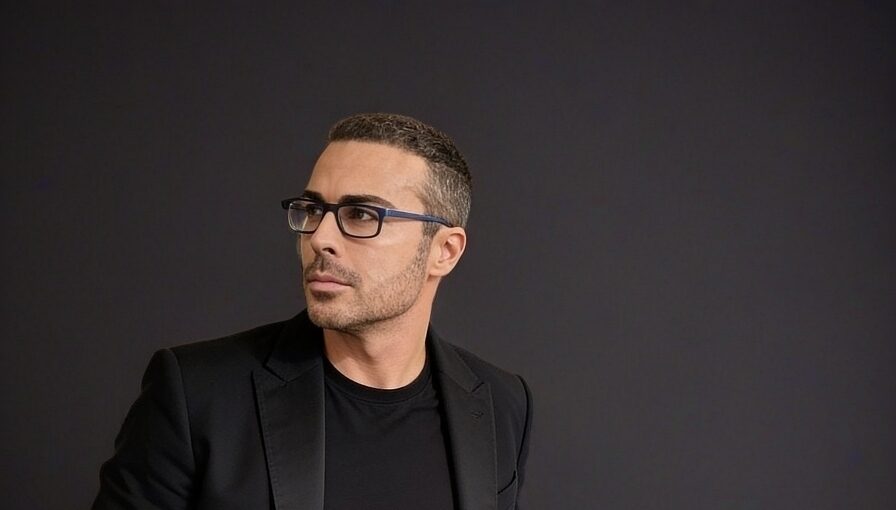

Haris Arvanitidis, a journalist and the Director of News and Current Affairs at ERT3 public television (Hellenic Broadcasting Corporation-ERT SA.), has built a distinguished and enduring career in journalism and media communication. With many years of professional experience, he has established himself as a respected voice in Greek broadcasting, contributing significantly to objective reporting, public information and television journalism. Through his role at ERT3, he has demonstrated leadership, integrity and dedication to high-quality news coverage, earning the trust and appreciation of audiences and colleagues alike. His successful presence in the media landscape reflects not only professional consistency and credibility but also a deep commitment to informing society with accuracy, responsibility and journalistic ethics throughout his remarkable and influential career in Greece.
After three decades at the heart of journalism, if you had to keep only one image or one voice that encapsulates what ‘ERT3’ means to you, what would it be and why?
The image I carry with me is not from a studio or an official office, but from a report from a remote borderland in Greece, where people’s only connection to the rest of the country was the ERT3 frequency.
I would choose the moment when a citizen in a remote area of the Greek countryside approached us not to “appear on television,” but to say to us: “You will listen to us.” For me, that phrase captures the entire essence of ERT3, because the third public television channel is not simply a station based in Thessaloniki, but a regional channel with national reach headquartered in Thessaloniki; it is the “echo” of every corner of Greece.
That “you will listen to us” transforms journalism from a profession into a mission. It means that we are a refuge of credibility and the connecting link of society. From 1996 until today, it is this expectation from citizens that keeps me alert. Whether I am in front of the camera or in an executive role, the goal remains the same: to justify the trust of that person who sees ERT3 as their own voice.
You began at ERT3 during the era of analog television and today you lead its news division in the age of ERTFLIX and artificial intelligence. What has remained non-negotiably the same in the way you approach a news story?
What has remained non-negotiable is the ethical prioritization of the “human factor” behind every story. In the analog era, we struggled with editing equipment, Beta tapes and bulky machines. Today, we struggle with algorithms and internet speed.
However, the essence of journalistic responsibility has not changed at all. Whether you record it in a notebook or process it with artificial intelligence, the news must be the truth and nothing but the truth. The journalist’s “filter” remains the only weapon against fake news.
At ERT (Hellenic Broadcasting Corporation), and naturally at ERT3, we were taught the “sacred duty” not to view the viewer as a “ratings unit,” but as a fellow citizen. That relationship of trust remains the same, whether someone watches us through a traditional antenna in their village, on demand from their mobile phone, or via the ERTFLIX platform.
Technology gave us speed, but journalism gives us meaning. Saying what happened is now easy. Explaining why it happened and how it affects the life of the person next to us remains the difficult and irreplaceable core of our work. The tools of our profession have changed, but the compass remains the same: journalism in the service of society, not sensationalism.
What do you consider the most important milestones in your career so far?
I did not simply begin a job; I began a lifelong relationship when I crossed the threshold of ERT3. That was the first major milestone in my career. At a time when television was changing rapidly, I chose to build my professional foundations first in reporting, learning the art of turning events into news before algorithms came to dominate newsrooms.
As a news and program presenter, I learned how, as a “mediator,” to transform the screen’s monologue into dialogue, placing the news in the foreground and making the interviewee the protagonist rather than an extra.
My transition to the “helm” of ERT3 News is perhaps the most demanding milestone, because it is the moment when the field journalist is called upon to become the architect of a strategy. My mission now is not to deliver the news, but to ensure that the entire ERT3 television, radio and internet mechanisms function as a unified, reliable “information ecosystem” for the benefit of the Greek citizen.
Assuming the role of ERT’s National Coordinator in the European Association of Regional Television Stations, CIRCOM Regional, is another important milestone, because it relates to outward-looking development and international recognition. I do not simply represent ERT; through ERT and with CIRCOM Regional as a vehicle, I seek to place Greek regional journalism on the European map, exchanging expertise and ensuring that the Greek voice is heard on equal terms.
How did you experience the transition from presenter to Director of News at ERT3?
As a presenter, your responsibility ends when the red camera light goes off. As a director, the light never goes off. Your success is no longer judged by how well you delivered the script or conducted an interview, but by whether your colleague’s report has the support it needs to stand out.
On set, you feel the safety of the team watching over you. In the director’s office, you are called upon to make decisions that are not always pleasing to everyone. You must learn to “hear” the silence or the “noise” in the corridors as carefully as you once listened to instructions through your earpiece.
ERT3 has a unique identity: it is the voice of the regions. The transition meant I had to stop thinking “what will we air today?” and start planning “where do we want ERT3 to be?” It is the difference between reading a map and charting a new route.
What is the greatest challenge facing ERT’s news division today?
The greatest challenge is not competition with private channels, but the battle against “digital noise” and the need for ERT to remain the “calm adult in the room.”
In a world where news “lives” for 30 seconds in a TikTok scroll, ERT is called upon to survive without surrendering to clickbait. The challenge is to make what is “important” just as “appealing” as what is merely “catchy,” without losing credibility.
The challenge is to transfer the prestige of journalism into the on-demand environment. How to transform a news bulletin or a program into an interactive experience that young people will choose to watch on their mobile phones between a series and a video game.
How do you manage internal tensions and disagreements within the journalistic team, especially those that occasionally become public?
Disagreements in journalism are often creative and concern the prioritization of a story or the perspective of a report. The challenge is not to let disagreement over the “issue” become a personal conflict.
I treat the newsroom like a living laboratory. Tensions are the “heat” of production. Without heat, the product is cold and lifeless. The secret is to maintain open channels so that pressure is released in meetings and not in hallways or on social media.
When disagreements become public, it usually happens because someone felt they were not heard internally. When the team sees that decisions are based on documented operational criteria and not on “closed offices,” resistance diminishes.
In difficult moments, I remind the team that our true judge is not the director or the colleague in the next office, but the citizen.
When the journalist’s ego gives way to the public servant’s duty, tensions diminish. However, internal tensions are the price of a pluralistic organization. My job is not to eliminate them, but to turn them into “fuel” for better journalism.
How important is your family’s support in the demanding daily life of a journalist?
For a journalist, family support is not simply a “safety net”; it is the only point of contact with normality when everything around you moves at the speed of breaking news.
Family is the people who force you to take the earpiece out of your ear and stop seeing the world as “content” or “reporting.” They remind you that behind news headlines, there are real lives, beginning with your own.
In journalism, it is not only you who works irregular hours; the whole household works alongside you. The family is the one that “pays” the price for your absence during holidays, birthdays, or critical moments because “something serious happened.” Their support is not mere encouragement, but a constant sacrifice of their own time on the altar of your mission.
At the end of a day full of tension, conflict, or pressure, family is the only place where you do not need to be “the presenter” or “the director.” There, you are simply the parent, the partner, the child. That emotional release allows you to return to the office the next day without being consumed by burnout. It is the only audience that does not judge you by ratings or credibility, but by your presence, even if that presence is physically limited but emotionally absolute.
Is there a family value or experience that has shaped the way you work and approach events?
I grew up in a family where, at the dinner table, the opinion of the youngest person carried the same weight as the eldest’s, provided an argument supported it. This translated into my work as “democratic listening.” Whether I speak with a politician or a citizen on the street, my approach is the same: I am not interested in titles, but in the truth of the moment.
One basic principle I inherited from my family is that “lies require memory, while truth requires nothing.” In journalism, this taught me not to fear silence or admitting a mistake. If you approach events with the same honesty with which you would discuss them with your father or mother, then the news acquires human weight, not merely informational value.
My family history, with ancestors who were Asia Minor refugees, is intertwined with displacement and the struggle for a new beginning. This instilled in me respect for the “ordinary person” struggling with history itself. That is why, in events, I never look only at the numbers, but at how the major decision affects the small household.
In essence, I do not see news as a professional duty, but as a promise I made to my own people, to my grandfather and grandmother: that I would never become part of the problem, but part of the explanation.
What is your view on the role of public television in modern Greek society?
In an era when information is abundant but truth is rare or difficult to distinguish, ERT must be the place where citizens turn to “clear” their perspective. Its role is not to be the first to say something, but the first to say it credibly. That is the difference between “noise” and “meaning.”
Through platforms such as ERTFLIX, public television becomes the guardian of our collective memory. It does not simply provide content; it provides identity. It is the connecting link for Greeks abroad, in the regions and in urban centers, creating a shared cultural code that commercial private media often overlook.
Public television has the luxury, which is simultaneously an obligation, of not chasing ratings at any cost. This makes it the only institution able to invest in cultural refinement, from an expensive drama series to a documentary about climate change.
How do you ensure objectivity and pluralism in the news bulletins you oversee?
I do not view a news bulletin as a mere sequence of facts, but as a structure in which every viewpoint must have its own “weight.” For me, pluralism is not simply giving everyone the microphone for a few seconds, but allowing arguments to clash on equal terms. If a story has two sides, the bulletin must reflect both, without distorting the lens.
At the BBC, they apply the principle of “reverential impartiality.” The journalist’s role is not to tell viewers what to think, but to provide them with the raw materials to build their own opinion. Objectivity is achieved when the journalist removes the adjective and keeps only the verb and the noun.
In the daily editorial meetings at ERT3, I encourage the team to question the “obvious” hierarchy of stories. If we all agree on something, then someone is not thinking hard enough. Pluralism begins in the newsroom itself; if we do not hear all the voices of our colleagues, how can we expect to hear all the voices of society?
In essence, objectivity is the “refusal of convenience.” It is the decision not to follow the current of social media or loud voices, but to remain the calm observer who respects the intelligence of the citizen.
What is your personal vision for the future of journalism in Greece?
My personal vision for journalism in Greece is the transition from the era of “speed” to the era of “trust.” I imagine journalism that is not “noise” in the citizens’ ears, but a reliable map to help them navigate reality.
In a world racing to beat the next second, my vision is journalism that dares to stop and explain “why.” I want to see Greek journalism invest in investigations that take months, rather than in stories that die within minutes. Truth needs time to mature.
With the advance of Artificial Intelligence, my vision is for journalists to cease being simple transmitters of information and become guarantors of authenticity. They must be the ones who distinguish deepfakes from human testimony, offering the one thing an algorithm cannot produce: empathy and moral judgment.
I envision journalism that will once again make Greek citizens feel safe when they begin a sentence with the phrase: “I heard it on the news.”